How Tee Height and Ball Position Can Help Senior Golfers Launch It Higher, Find the Center of the Face, and Get More From Their Driver
One of the easiest ways for senior golfers to gain more from the driver is to check driver tee height for senior golfers and ball position before making another swing change.
8 minutes read time
As senior golfers, we spend a lot of time looking for ways to hit the driver farther. We try a new driver, change shafts, work on our turn, or try to find a few more miles per hour of clubhead speed.
But what if you’re giving away distance before you even start the backswing? Two of the simplest things to check are tee height and ball position.
Sponsored Links
Neither requires a swing change. Neither requires hours on the range. And neither costs you anything.
Yet a ball teed too low or positioned poorly in your stance can make it much more difficult to launch your driver efficiently and consistently find the center of the face.
For golfers over 60, these little setup adjustments can become even more important. Our swing may not be exactly the same as it was 20 or 30 years ago. We may have a little less speed, a shorter turn, or simply move differently.
Instead of fighting those changes, let’s make our setup work with the swing we have today.
Modern drivers are designed to launch the golf ball.
Unlike an iron, where we’re generally trying to strike the ball with a descending blow, a driver often performs best when we catch the ball with the club moving level to slightly upward through impact.
That’s where tee height becomes important.
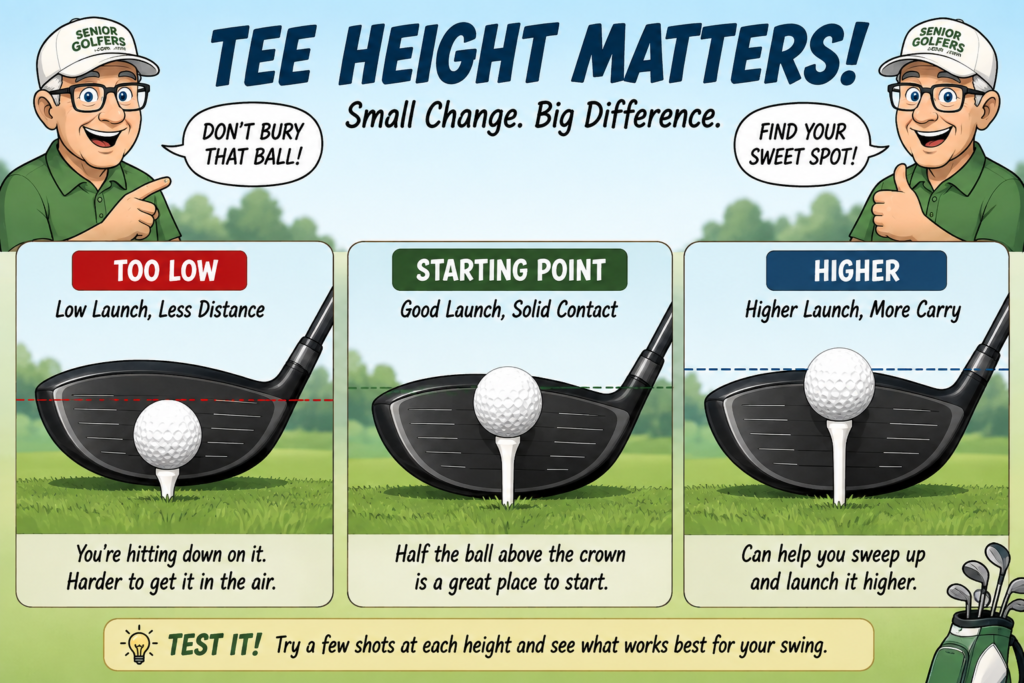
Tee the ball extremely low and you may encourage yourself to hit down on it. You can also make it harder to strike the upper-center portion of the driver face.
Tee it too high, however, and some golfers start changing their swing just to get to the ball. Neither extreme is ideal.
Senior Insight
Before you spend money chasing more distance, experiment with your tee height. USGA research has shown that tee height can affect launch conditions and driving distance. For senior golfers, that makes tee height one of the easiest—and cheapest—things to test. Start with about half the ball above the driver crown, then try it slightly higher and lower to see where you get your best combination of launch, contact, and distance.
With the driver resting on the ground behind the ball, have approximately half the golf ball above the top edge of the driver’s crown.
Sponsored Links
This isn’t a rule.
It’s a starting point.
Your ideal tee height might be slightly higher or slightly lower depending on your driver, swing and angle of attack.
That’s why experimenting is so valuable.
For many senior golfers, I’d rather see them experiment with teeing the ball a little higher than continually pushing the tee farther into the ground.
A slightly higher tee can give you room to sweep the driver through the ball rather than feeling as though you have to chop down at it.
Ball Position Can Change Your Driver Without Changing Your Swing
Now let’s look at the second half of the equation: driver ball position.
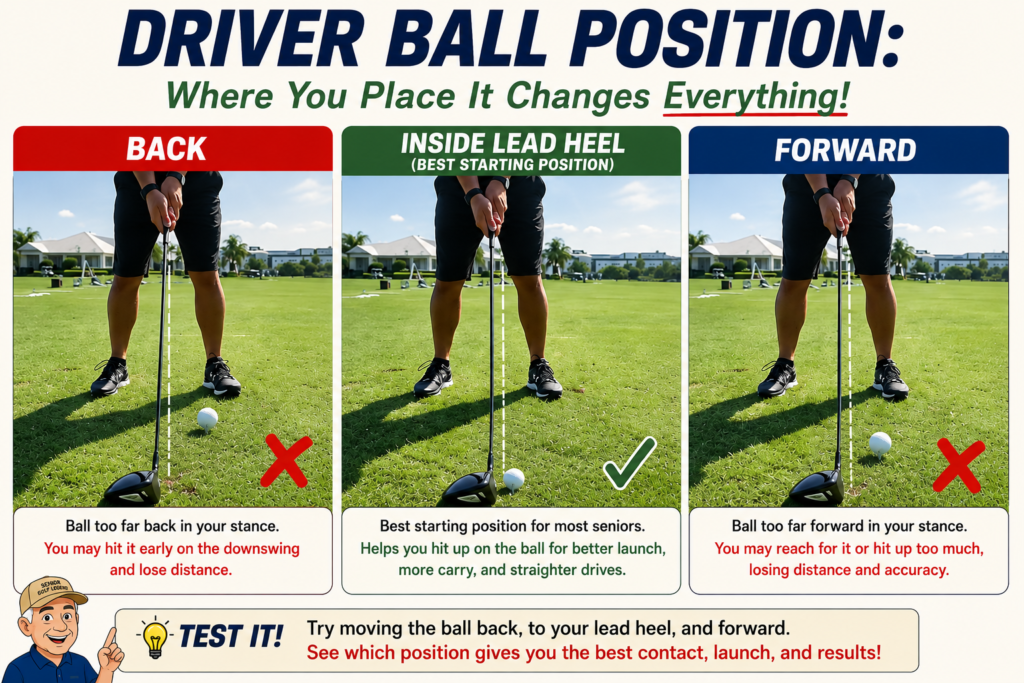
A traditional starting position is to place the ball around the inside of your lead heel.
For a right-handed golfer, that’s your left heel.
Why?
Because the driver swing generally reaches its low point before the club gets to the ball. The club can then begin traveling slightly upward as it reaches impact.
Move the ball too far back and you may catch it earlier in the swing arc.
Sponsored Links
Move it too far forward and you may have to reach for it or wait too long for the clubhead to arrive.
Again, we’re looking for a starting point—not a universal rule.
At Senior-Golfers.com, we focus specifically on how the golf swing, equipment, and practice change after 60. If you’re looking for senior-friendly golf advice, start here.
Senior Golfers Shouldn’t Be Afraid to Experiment
This is where I think golfers over 60 sometimes make a mistake.
We remember where we were taught to put the ball years ago, and we continue putting it there.
But our swing may have changed.
Maybe your hip turn isn’t quite as large.
Maybe you’ve widened your stance.
Maybe you’re standing a little taller.
Maybe you’ve lost 5 or 10 mph of driver speed.
Or perhaps you’ve changed to a modern 460cc driver with more loft and a completely different shaft than the driver you used 20 years ago.
Why should we automatically assume the same ball position is still perfect?
We shouldn’t.
Your goal isn’t to make your setup look exactly like a picture in a golf instruction book.
Your goal is to consistently find the center of the face and produce a useful launch.
The Relationship Between Tee Height and Ball Position
Here’s where things get interesting.
Tee height and ball position work together.
Move the ball slightly forward and tee it higher, and you may find it easier to catch the driver on the upswing.
Move the ball back and tee it low, and you may encourage a more downward strike.
That’s why changing several things at once can be confusing.
If you hit a great drive, you don’t know what helped.
If you hit a terrible one, you don’t know what caused it.
Instead, change one variable at a time.
Try This Simple Driver Test
The next time you go to the range, take 15 balls and divide them into three groups of five.
Start with your normal ball position—approximately inside the lead heel.
Then test three tee heights:
Balls 1–5: Tee slightly lower than normal.
Balls 6–10: Tee approximately half the ball above the driver’s crown.
Balls 11–15: Tee slightly higher.
Don’t worry about hitting these drives as far as possible.
Make your normal swing.
Pay attention to three things:
Where did the ball hit the face?
How high did the ball launch?
What happened to the direction and distance?
If you have impact tape or foot spray, this is a perfect time to use it.
You might discover something surprising.
The highest tee isn’t necessarily going to produce your longest drives. You’re looking for the height that helps you repeatedly strike the center or slightly above center of the face while producing a good trajectory.
Now Test Ball Position
Once you’ve found a comfortable tee height, perform another simple test.
Hit five drives from your normal position.
Then move the ball approximately one ball-width farther back and hit five more.
Finally, move it approximately one ball-width farther forward than your normal position and hit five.
That’s enough.
We’re not trying to completely rebuild your driver swing.
We’re trying to discover whether a small setup adjustment produces better results.
You may find that moving the ball only an inch changes your contact considerably.
Don’t Judge It By Your Best Drive
This is important.
Don’t choose a tee height or ball position because you hit one monster drive.
Look at all five shots.
I’d much rather find a setup that gives me five solid drives than one drive that’s 15 yards longer followed by four balls scattered across the golf course.
As senior golfers, usable distance matters.
A 230-yard drive in the fairway is considerably more valuable than a 245-yard drive behind a tree.
Your best setup should produce a combination of:
Center-face contact
Good launch
Consistent direction
Reliable carry distance
Confidence when you stand over the ball
That’s the setup you take to the golf course.
What About the 3-Wood?
Don’t use your driver tee height for your fairway woods.
When hitting a 3-wood from the tee, I like the idea of creating a perfect fairway lie.
Tee it low enough that the ball is just sitting above the grass.
You’re not trying to sweep underneath it like a driver.
You’re simply removing the possibility of a poor lie and giving yourself a clean opportunity to strike the middle of the face.
This can be especially useful on tight par 4s where accuracy is more important than squeezing another 15 yards out of the driver.
Ball Position With Your Irons
The same principle applies throughout the bag, although the setup changes.
Generally, longer clubs are played farther forward and shorter clubs move progressively toward the center.
But once again, don’t become obsessed with an exact inch measurement.
Your body proportions, stance width and swing are different from another golfer’s.
Instead, pay attention to where your club is contacting the ground and where you’re striking the face.
If you’re constantly making poor contact, ball position should be one of the first things you check before deciding that your swing has suddenly disappeared.
Before Buying More Distance, Check Your Setup
Golf equipment today is incredible.
Modern drivers, lightweight shafts and golf balls can absolutely help senior golfers.
But a $600 driver can’t completely overcome poor contact.
Before spending money trying to gain another 10 yards, spend 20 minutes on the range experimenting with your tee height and ball position.
You might already own the distance you’re looking for.
Sometimes the answer isn’t swinging harder.
Sometimes it’s simply giving your driver a better opportunity to do what it was designed to do.
And the best part?
Moving your tee up half an inch is free.
The Senior Golfer Takeaway
As we get older, golf becomes less about forcing our bodies to make the swing we had at 30 and more about getting the most out of the swing we have today.
Start with the basics.
With your driver, begin with roughly half the ball above the crown and the ball positioned around the inside of your lead heel.
Then experiment.
Move the tee slightly higher or lower. Move the ball forward or back by one ball-width. Hit enough shots to see a pattern rather than judging the experiment by one swing.
The goal isn’t to find the setup that produces your longest drive.
It’s to find the setup that gives you your best drives more often.
That’s the kind of distance that actually lowers scores.
Frequently Asked Questions About Driver Tee Height and Ball Position
How high should a senior golfer tee the ball with a driver?
A good starting point is to tee the ball so about half of the golf ball sits above the top of the driver’s crown when the club is resting on the ground. From there, experiment slightly higher and lower. The best tee height is the one that produces consistent center-face contact, good launch and reliable distance.
Where should the ball be positioned when hitting a driver?
For most right-handed golfers, start with the ball positioned around the inside of the left heel (lead heel). Left-handed golfers would use the inside of the right heel. This forward position gives the clubhead an opportunity to reach the ball after the low point of the swing and can help promote an upward strike.
Should senior golfers tee the driver higher?
It can be worth trying. A slightly higher tee may help some senior golfers launch the ball higher without needing additional clubhead speed. However, higher isn’t automatically better. Experiment with several tee heights and compare launch, contact, direction and carry distance.
Can tee height really affect driver distance?
Yes. Tee height influences where the ball contacts the driver face and can influence launch conditions. If you’re consistently striking the ball too low on the face, changing tee height may improve contact and help you get more distance from the clubhead speed you already have.
What happens if I tee my driver too low?
A very low tee can make it more difficult for some golfers to hit the driver with an upward angle of attack and may contribute to low-face contact and a lower trajectory. If your drives consistently come out low, tee height is one of the first things worth checking.
What happens if the driver ball position is too far back?
Playing the driver too far back can cause you to contact the ball earlier in the swing arc. Depending on your swing, this can contribute to a lower launch, different face/path relationship and inconsistent contact.
Can the driver ball be too far forward?
Yes. Moving the ball excessively forward can cause you to reach for it or make compensations to square the clubface. If you’re getting heel strikes, pulls, blocks or inconsistent contact, check whether your ball has gradually moved too far forward.
What’s more important: tee height or ball position?
Both work together. Ball position affects where the club meets the ball along the swing arc, while tee height affects where you can contact the ball on the driver face. Instead of changing both simultaneously, test one variable at a time so you know which adjustment actually helped.
What’s the easiest way to find my best driver setup?
Take 15 balls to the practice range and hit five from a low tee, five from your normal tee height and five from a slightly higher tee. Once you find the best height, repeat the test with your ball position—slightly back, inside the lead heel and slightly forward.
Don’t judge the test by your single longest drive. Look for the setup that produces the best contact and most consistent drives.
Do I need to swing harder to gain driver distance after 60?
Not necessarily. Before trying to increase swing speed, check your fundamentals. Better tee height, ball position and center-face contact can help you get more from the speed you already have. For many senior golfers, better contact is a much easier path to usable distance than simply swinging harder.
🔔Want more senior-specific golf tips? Join the Senior-Golfers.com Newsletter and get practical advice, equipment insights, and bonus guides delivered monthly — no spam.
AI golf instruction is becoming one of the newest ways golfers can use artificial intelligence to improve their game. AI can already write an email, plan a vacation, answer questions, analyze photographs—and now it can even analyze your golf swing. But can it actually help you play better golf? That was the question I wanted…
Sometimes the best golf memories aren’t made on the golf course—they’re made afterward. 2-night golf getaways for senior golfers are one of the best ways to enjoy great golf, reconnect with friends, and recharge without spending a week away from home. Sometimes, the best golf memories aren’t made by shooting your lowest score—they’re made around…
Summer is one of the best times of the year to play golf. The days are longer, courses are in great condition, and many of us are playing two or three times a week—or even more. But there’s one mistake I see senior golfers make over and over again every summer. It’s not swinging too…
Allen is a seasoned golfer who has been playing the sport for over 50 years, mostly in the Northwest, and now calls Idaho home. Throughout his life, he has actively participated in various sports, including snowboarding and windsurfing in the Columbia Gorge. Allen passionately believes that “Golf is Life” and is dedicated to helping fellow senior golfers make the most of their senior years









Comments