Cold weather golf after 60 can be frustrating. The temperature drops, the fairways get softer, and suddenly the club that easily reached the middle of the green in July starts coming up short. If your 7-iron suddenly starts coming up short in October, don’t assume you’ve lost your swing.
It happens to me, too.
9 minutes read time
The temperature drops, the fairways get softer, we put on another layer of clothing, and suddenly the club that easily reached the middle of the green in July isn’t getting there anymore.
For senior golfers, this can be especially frustrating. We’re already working hard to maintain distance as we get older. The last thing we need is to lose another five or ten yards because the weather changed.
But here’s the good news:
You probably haven’t suddenly lost that distance permanently.
Cold air, a cold golf ball, softer turf, extra clothing, and a body that takes longer to loosen up can all contribute.
So before you start changing your swing—or shopping for another new driver—try these seven adjustments.
1. Understand What Cold Air Does to Your Golf Ball
There is real science behind what you’re seeing.
Cold air is denser than warm air. That increased density creates more drag as the golf ball flies through the air.
TrackMan data cited by Golf Digest estimates roughly one yard of carry difference for every 10-degree change in temperature, although the exact effect depends on the shot and conditions.
Other testing has produced somewhat larger estimates, which is a good reminder that there isn’t one magic formula that applies to every golfer and every shot.
The important lesson isn’t whether you’re losing exactly four yards or seven.
Expect the ball to fly shorter when it’s cold.
If you’re standing 155 yards from the green in July and comfortably hitting a 7-iron, that same 7-iron may not be the right club on a 45-degree October morning.
Senior Insight
Don’t make a perfect swing with the wrong club.
If you’re between clubs in cold weather, take the longer club and make your normal, balanced swing rather than trying to squeeze five extra yards out of the shorter one.
Remember when we could get out of the car, grab the driver, take three swings and head to the first tee?
Those days may be gone.
Cold weather makes it even more important to get your body moving before asking it to make a full-speed golf swing.
A useful warm-up doesn’t have to take 30 minutes. Recent senior-golf fitness guidance emphasizes progressive movement—getting the body moving, working on hip and torso mobility, and gradually building up to full golf swings.
Try this simple five-minute routine:
Walk briskly for a minute.
Make 10 controlled torso rotations.
Make 10 gentle hip rotations.
Take 10 slow practice swings.
Finish with five progressively faster swings.
You’re not trying to create speed records in the parking lot.
You’re trying to arrive on the first tee ready to swing.
Senior Insight
If it normally takes you four holes to “find your swing” on a cold morning, your swing may not be the problem.
Your body may simply need more time to warm up.
3. Stop Trying to Swing Harder
This is one of the biggest mistakes I see—and I’ve made it myself.
You hit an iron that comes up short.
On the next hole, you think:
I’ve got to hit this one harder.
Your backswing gets longer. Your transition gets quicker. Your balance disappears.
And you hit it even shorter.
Instead, do something that feels almost too simple:
Take one more club.
If you normally hit an 8-iron, hit a 7.
Grip down slightly if necessary and make a smooth swing.
For most senior golfers, center-face contact is going to produce more reliable distance than trying to manufacture another five miles per hour of clubhead speed.
4. Remember: Carry Distance Isn’t the Only Thing Changing
There’s another reason your fall drives may look disappointingly short.
The ground is different.
Summer fairways can be firm and fast. A drive may land at 220 yards and finish at 240.
That same drive on a damp October morning may land at 215 or 220 and stop shortly afterward.
Cooler fall conditions commonly mean softer turf and substantially less rollout. Golf
That’s important because golfers tend to remember total distance.
Your driver may not have suddenly lost 20 yards of carry.
You may have lost a few yards of carry—and another 10 or 15 yards of roll.
Those are two completely different problems.
Senior Insight
Know your carry number, not just your total distance.
Carry is the number that gets you over a bunker, pond or forced carry. Roll is a bonus that changes with course conditions.
5. Recheck Your Distances
This is a perfect time to use technology.
If you have access to a launch monitor, hit eight to ten shots with several important clubs:
Driver
Fairway wood or hybrid
7-iron
Wedge
Ignore your best shot and your worst shot.
Look at your normal carry distance.
You may discover your 7-iron isn’t a 155-yard club on a cool fall morning. Maybe it’s 148.
That’s valuable information.
You don’t need to fix that.
You need to know it.
Golf becomes much easier when we stop playing the distances we think we hit and start playing the distances we’re actually hitting today.
This also fits perfectly with the AI golf-instruction approach we’ve discussed here at Senior-Golfers.com: gather real information before trying to fix something that may not be broken.
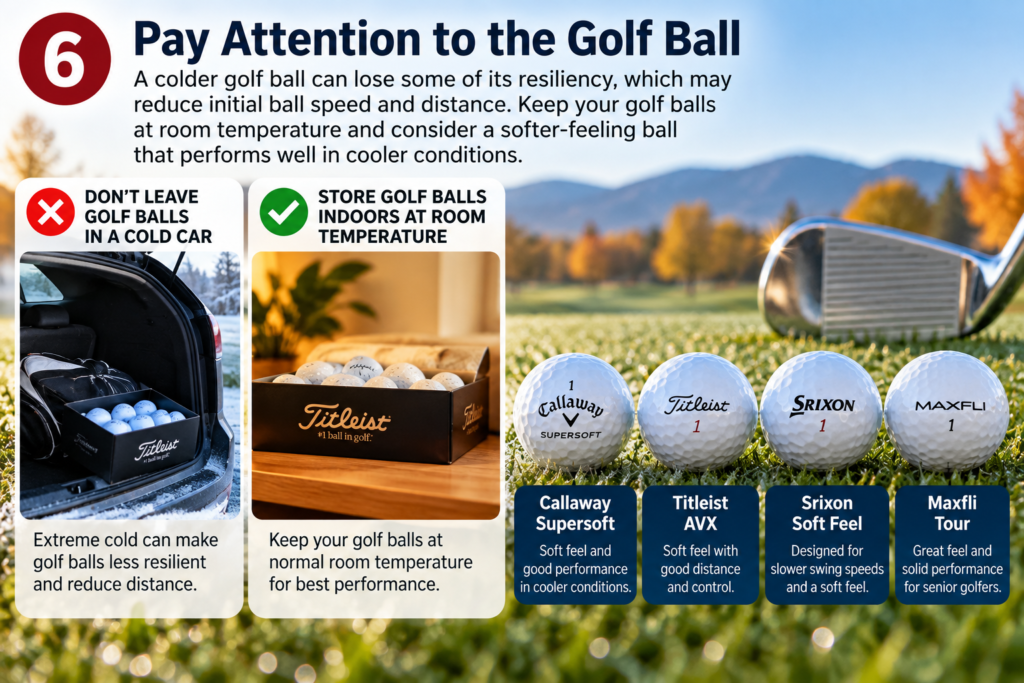
6. Pay Attention to the Golf Ball
The golf ball itself can also be affected by temperature.
Titleist explains that colder golf balls can lose some resiliency, reducing initial velocity. The company recommends storing golf balls indoors at room temperature rather than leaving them exposed to extreme temperatures, such as overnight in a freezing car trunk. Titleist
That’s an easy one.
Don’t leave your golf balls in the garage or trunk all night before a cold morning round.
I also think fall is an excellent time for senior golfers to experiment with golf balls.
Some players prefer a softer-feeling ball as temperatures fall. The Callaway Supersoft, for example, continues to appear in cold-weather golf-ball testing and recommendations.
But don’t assume lower compression automatically means longer for every golfer.
Try a few balls and pay attention to driver distance, iron flight and—most importantly—how the ball performs around the green.
Senior Insight
You don’t need the golf ball your playing partner uses.
You need the golf ball that works with your swing.
7. Change Your Expectations Before You Change Your Swing
This may be the most important fall golf tip of all.
Suppose you normally drive the ball 240 yards.
On a cold, damp morning you hit one 225.
What’s your first thought?
I’m losing distance.
Maybe.
But maybe the ball carried five yards shorter and rolled ten yards less.
That’s not an aging problem.
That’s an October problem.
Golfers over 60 need to be especially careful about reacting to every short shot by changing technique.
If you’ve been hitting the ball well all summer, don’t rebuild your golf swing because you played one cold round.
Adjust your club selection.
Warm up.
Keep the golf ball at a reasonable temperature.
Pay attention to carry.
And keep making your normal swing.
Play Smarter This Fall
There’s a point in golf after 60 where playing smarter becomes more valuable than simply trying to swing harder.
Fall golf is a perfect example.
If it’s 45 degrees, the fairways are damp and you’re wearing three layers, you’re probably not going to hit the ball exactly as far as you did on a 78-degree afternoon in July.
That’s okay.
Take another club.
Make a balanced swing.
And enjoy being out there.
Because the goal isn’t to prove that we can still hit our 7-iron the same distance we did 20 years ago.
The goal is to keep playing good golf for the next 20 years.
At Senior-Golfers.com, we focus specifically on how the golf swing, equipment, and practice change after 60. If you’re looking for senior-friendly golf advice, start here.
Frequently Asked Questions
How much distance does a golf ball lose in cold weather?
There isn’t one exact number for every golfer. TrackMan information cited by Golf Digest estimates roughly one yard of carry change for each 10-degree temperature change, while other testing has shown somewhat larger effects. Ball temperature, swing speed, wind, humidity and strike quality also matter. Golf Digest
Should senior golfers use a softer golf ball in cold weather?
It can be worth testing. Many golfers prefer the feel of lower-compression balls in colder conditions, but there isn’t one compression that’s automatically best for every senior golfer. Test performance from the tee through the green.
Should I take an extra club when it’s cold?
Often, yes. If you’re between clubs, taking the longer club and making a controlled swing is usually preferable to trying to force additional distance from the shorter club.
Should I keep golf balls warm before playing?
Store them indoors at normal room temperature rather than leaving them overnight in a cold car or garage. Titleist specifically recommends avoiding extreme storage temperatures. Titleist
Why does my driver lose so much distance in the fall?
Part of what you’re seeing may be reduced carry, but softer fairways also produce less roll. Compare carry distance rather than only looking at where the ball finishes.
🔔Want more senior-specific golf tips? Join the Senior-Golfers.com Newsletter and get practical advice, equipment insights, and bonus guides delivered monthly — no spam.
AI golf instruction is becoming one of the newest ways golfers can use artificial intelligence to improve their game. AI can already write an email, plan a vacation, answer questions, analyze photographs—and now it can even analyze your golf swing. But can it actually help you play better golf? That was the question I wanted…
How Tee Height and Ball Position Can Help Senior Golfers Launch It Higher, Find the Center of the Face, and Get More From Their Driver One of the easiest ways for senior golfers to gain more from the driver is to check driver tee height for senior golfers and ball position before making another swing…
Sometimes the best golf memories aren’t made on the golf course—they’re made afterward. 2-night golf getaways for senior golfers are one of the best ways to enjoy great golf, reconnect with friends, and recharge without spending a week away from home. Sometimes, the best golf memories aren’t made by shooting your lowest score—they’re made around…
Allen is a seasoned golfer who has been playing the sport for over 50 years, mostly in the Northwest, and now calls Idaho home. Throughout his life, he has actively participated in various sports, including snowboarding and windsurfing in the Columbia Gorge. Allen passionately believes that “Golf is Life” and is dedicated to helping fellow senior golfers make the most of their senior years






Comments