There’s a moment that happens to almost every golfer over 60.
You’re on the range. You make a swing. And you think:
“That didn’t used to feel this hard.”
Not painful. Not broken.
Sponsored Links
Just… harder.
At Senior-Golfers.com, we focus specifically on how the golf swing, equipment, and practice change after 60. If you’re looking for senior-friendly golf advice, start here.
The backswing feels shorter. The follow-through feels restricted. Your balance feels slightly off. And the swing that once felt automatic now feels like something you have to work at.
So you do what we all do.
You look for a swing tip.
Sponsored Links
You watch a video. You read an article. You try to “fix” something.
Maybe you try to turn more. Maybe you try to clear your hips faster. Maybe you try to create more lag.
And instead of feeling better…
Your swing feels more confused.
Sponsored Links
Here’s the part nobody really tells senior golfers:
Most swing problems after 60 are not mechanical.
They’re physical.
They’re mobility-related.
They’re range of motion.
And until you understand what your body can (and can’t) do today, no swing tip in the world is going to stick.
Before you change your swing, you need to test something first.
You need to test your range of motion.
Why This Matters So Much After 60
When you were 40, you could copy a swing tip and your body could usually figure it out.
Your hips turned. Your shoulders rotated. Your balance held up. Your spine moved freely.
Now?
Your body has different rules.
Hips don’t rotate like they used to
Shoulders don’t turn as freely
Upper back gets stiff
Balance isn’t automatic anymore
Flexibility isn’t something you can ignore
So when an instructor says:
“Just turn more.”
Your body quietly replies:
“We don’t do that anymore.”
That’s when frustration starts.
That’s when golfers think:
“I’m getting worse.”
You’re not getting worse.
You’re trying to swing like a younger version of yourself.
And that’s the real problem.
Try These Two Tests Right Now
No gym. No stretching routine. No equipment.
Just you and a little honesty.
These two tests alone will tell you more about your swing than most lessons.
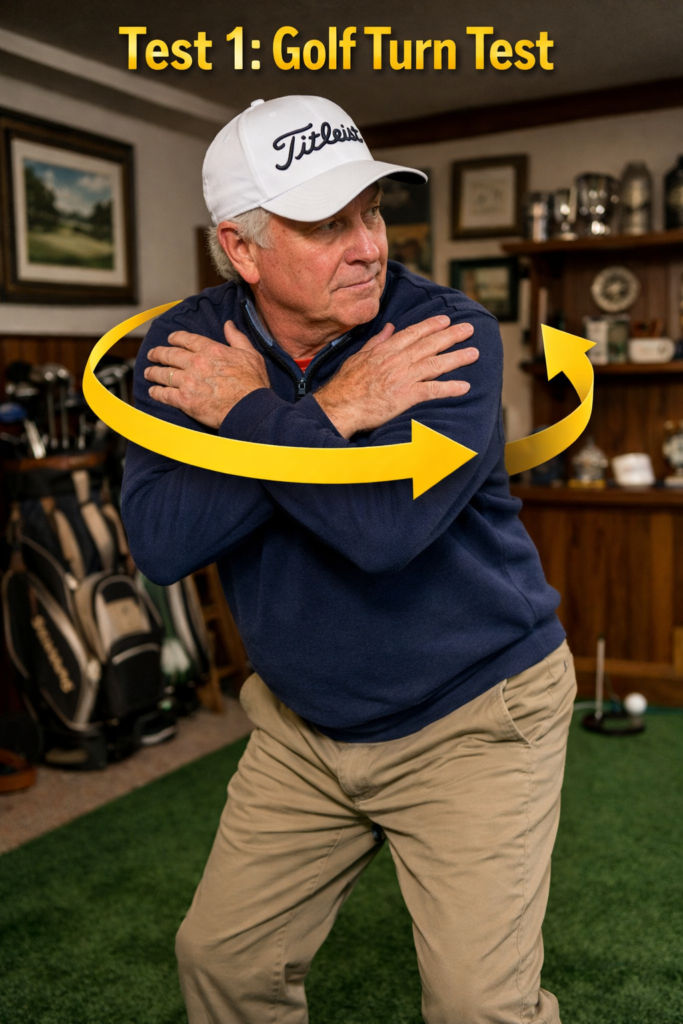
✅ Test 1 — Shoulder Turn (The Golf Turn Test)
How to do it:
Cross your arms over your chest
Get into golf posture
Rotate your shoulders like a backswing
Keep your hips quiet
What you’re looking for:
Can you turn your shoulders at least 70–80 degrees without strain?
What this reveals
If you can’t turn, you physically cannot make a full backswing — no matter how many videos tell you to.
This directly affects:
Backswing length
Solid contact
Consistency
Ability to create speed
If this feels tight, that’s not a swing flaw.
That’s a mobility limitation.
And this is where many seniors realize:
“I’ve been trying to fix the wrong thing.”
✅ Test 2 — Balance (The Shoe Test)
This one surprises almost everyone.
How to do it:
Stand on one foot
No holding onto anything
Try for 20 seconds each side
If you need to grab something, score it low.
What this reveals
Poor balance leads to:
Fat shots
Thin shots
Inconsistent contact
Feeling “out of sync” in your swing
Losing stability late in the round
You cannot make a repeatable golf swing without balance.
And most seniors don’t realize this is the hidden issue.
What Most Seniors Realize After These Two Tests
After trying just these two, golfers usually say:
“Well… that explains a lot.”
Because for the first time, it’s clear:
This isn’t a technique problem.
It’s a body problem.
And that’s actually very good news.
Because you stop trying to force movements your body can’t make.
Why Most Swing Advice Fails Before It Even Starts
After trying these two tests, many senior golfers feel a strange mix of relief and frustration.
Relief because things suddenly make sense. Frustration because they realize how long they’ve been trying to fix the wrong problem.
Most swing advice fails for golfers over 60 before it even starts — not because the advice is wrong, but because the body receiving the advice has changed.
Golf instruction assumes you can:
Turn your shoulders fully
Rotate your hips freely
Maintain perfect balance without effort
Hold posture comfortably through the swing
Those used to be automatic.
Now they require effort.
And when movements require effort, they stop being repeatable.
That’s why you can hit a few good shots on the range trying a new tip… and then completely lose it on the course.
Your body can do it once or twice. It just can’t do it consistently anymore.
This is also why many seniors feel like their swing has become “hard work.”
Not because golf got harder.
Because your body is asking for a different approach.
This is the exact same pattern many golfers notice when watching YouTube golf tips that confuse golfers over 60. The advice sounds great — but it doesn’t match what their body can comfortably do.
And this is where simple mobility work, like what’s shown in the Senior Golfer Stretch Guide, often produces better results than any swing thought.
Because when your body moves a little easier, your swing often cleans itself up.
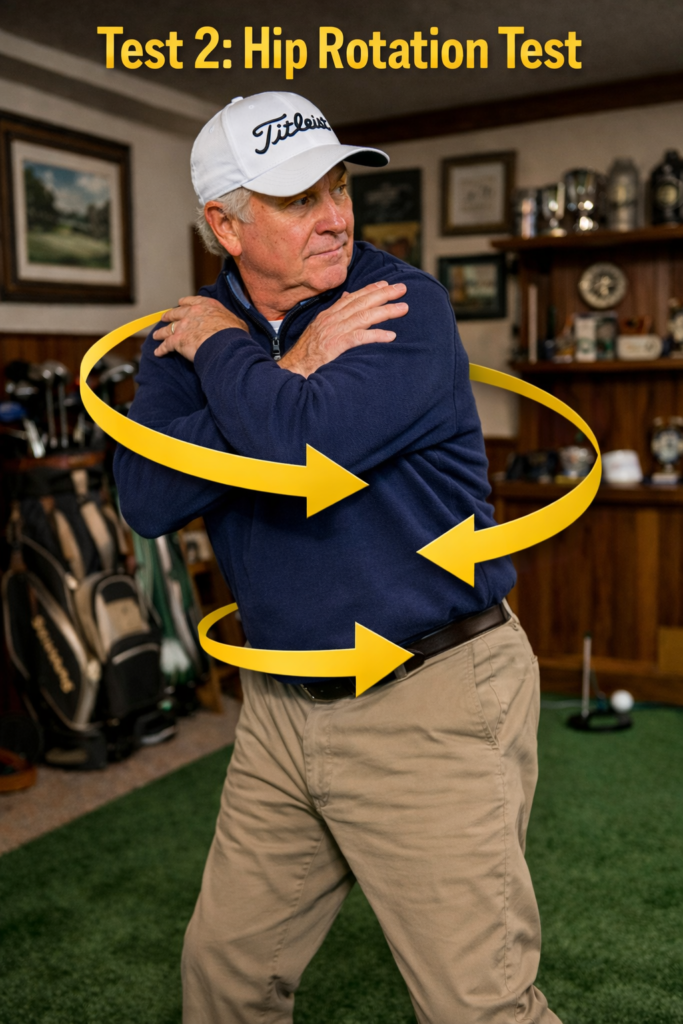
There Are 5 Total ROM Tests Every Senior Golfer Should Know
These two are just the beginning.
There are five total tests that check:
Shoulder mobility
Hip rotation
Upper back stiffness
Balance
Hip flexibility
When you score all five together, the picture becomes very clear.
You see exactly why certain swing tips feel impossible.
Download the Full ROM Self-Rating Guide
I put together a simple, visual guide that includes:
It takes about five minutes to go through, and it might change how you think about your swing this season.
The Big Realization
If your mobility is limited, the problem isn’t:
Your effort
Your practice habits
Your ability to swing
It’s that you’re trying to swing like a younger version of yourself.
And once you understand that, something powerful happens.
You stop chasing swing tips.
You start playing the swing you have now.
This is also why equipment and setup start to matter more than mechanics. Many golfers find that changes discussed in club fitting for senior golfers or even stability-focused equipment like LAB putters for senior golfers suddenly make more sense once they understand their mobility limitations.
That’s when golf starts to feel easier again.
Senior Insight
Most golfers over 60 don’t need more instruction.
They need more understanding of their own mobility.
Once you see that clearly, frustration fades and confidence starts to come back.
Why the Right Compression Ball Can Add Distance and Control for Senior Golfers At Senior-Golfers.com, we focus specifically on how the golf swing, equipment, and practice change after 60. If you’re looking for senior-friendly golf advice, start here. 9 minutes read time Just want the quick answer? ⭐ Quick Summary: Best Golf Balls for Senior…
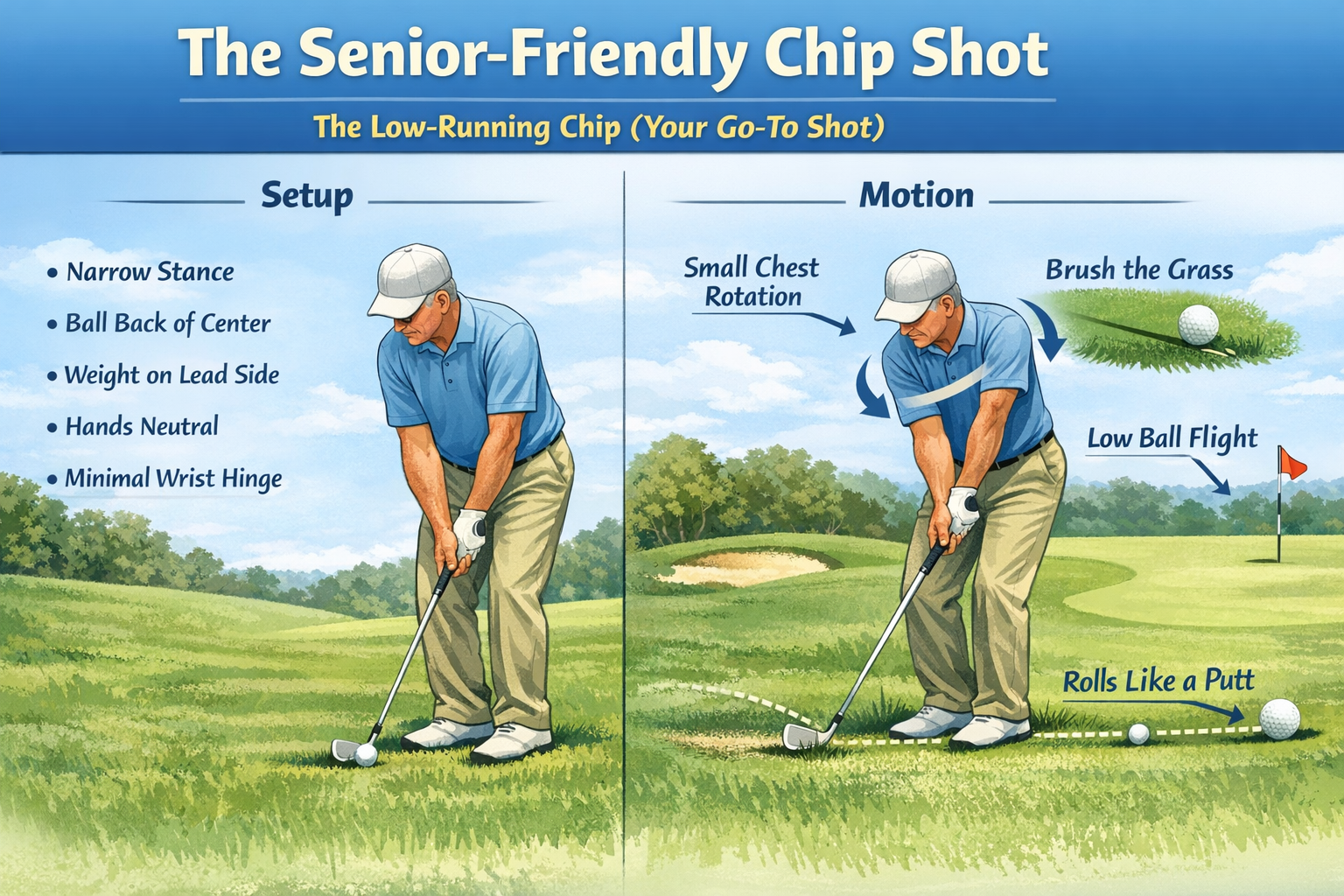
If there’s one part of golf that truly belongs to experienced players, it’s the short game for seniors. After 60, we may lose a little swing speed. We may not hit it as far as we once did. But scoring? Scoring still belongs to the golfer who controls the ball from 100 yards and in.…
The shoulder turn in golf is a crucial component of a successful golf swing. It is a fundamental movement that allows golfers to generate power, maintain accuracy, and achieve optimal distance. While it may seem simple, mastering the shoulder turn can be challenging, especially for senior golfers. In this post, we will explore some tips…
Allen is a seasoned golfer who has been playing the sport for over 50 years, mostly in the Northwest, and now calls Idaho home. Throughout his life, he has actively participated in various sports, including snowboarding and windsurfing in the Columbia Gorge. Allen passionately believes that “Golf is Life” and is dedicated to helping fellow senior golfers make the most of their senior years
[…] In fact, this is often less about technique and more about mobility. You can see this clearly in the simple ROM tests every senior golfer should try before changing their swing. […]
YouTube Golf Tips Frustrate Golfers Over 60 (Here’s Why)
[…] exactly like it used to, the golf clubs you once played with may no longer match your motion. ROM tests every senior golfer should do before changing their swing — tests that often explain why tips and drills alone don’t […]
Off-Season Golf Plan for Seniors: What to Do From November to February
[…] is exactly why ideas like ROM tests every senior golfer should do before changing their swing are so valuable. They show you exactly where your motion is restricted — not just what you feel […]
Senior Golfers Shoulder Turn: More Distance After 60








Comments
[…] In fact, this is often less about technique and more about mobility. You can see this clearly in the simple ROM tests every senior golfer should try before changing their swing. […]
[…] You can see those tests here:👉 ROM Tests Every Senior Golfer Should Do Before Changing Their Swing […]
[…] exactly like it used to, the golf clubs you once played with may no longer match your motion. ROM tests every senior golfer should do before changing their swing — tests that often explain why tips and drills alone don’t […]
[…] is exactly why ideas like ROM tests every senior golfer should do before changing their swing are so valuable. They show you exactly where your motion is restricted — not just what you feel […]
[…] ROM Tests Every Senior Golfer Should Do Before Changing Their Swing […]