Senior Golf Practice: A Complete Guide to Effective Training
By Allen Pedersen
As golf continues to be a beloved sport among seniors, it’s crucial for older athletes to adopt practice strategies tailored to their unique needs. Senior golfers face different physical limitations, flexibility changes, and energy dynamics compared to younger players. Yet, with the right mindset and structured practice routines, senior golfers can continue to improve, enjoy the game, and even lower their scores. This post provides a complete guide for senior golfers on how to practice efficiently and safely, with actionable tips and routines designed for the mature athlete. Senior Golf Practice.
7 minutes read time.
Sponsored Links
Understanding the Senior Golfer
Before diving into practice routines, it’s important to understand the senior golfer’s landscape:
Physical changes: Aging brings a natural decline in muscle mass, flexibility, and balance. This does not mean performance must suffer—rather, practice must adapt to these realities.
Experience advantage: Senior golfers often have years of knowledge and course management skills that can offset physical limitations.
Health and injury prevention: With age, the risk of injury—especially to the back, shoulders, and knees—increases, emphasizing the need for proper warm-up and technique.
The Importance of Mindset
A positive, adaptable mindset underlies effective practice for seniors. Recognize that improvement is always possible, but may look different than when you were younger. Embrace goals like consistency, accuracy, and enjoyment, not just power or distance.
We advise you to consult your physician before making any changes to your diet and exercise routine.
Step 1: Warm-Up and Mobility
Why Warm-Up Matters
A proper warm-up routine is essential to prepare older muscles and joints, reduce injury risk, and optimize performance.
Warm-Up Routine for Senior Golfers
Dynamic stretches (5-10 min): Arm circles, torso twists, and ankle rolls to gently increase range of motion.
Light aerobics: Brisk walking or marching in place for several minutes to get the blood flowing.
Golf-specific movements: Slowly swing two clubs together, practice air swings focusing on smooth acceleration and follow-through.
Tip: Don’t skip warming up, even if practicing the short game only.
Step 2: Building Fundamentals
Success in golf is built on solid fundamentals. For seniors, keeping these sharp is essential:
Sponsored Links
Grip check: With reduced grip strength, ensure your grip is secure but not too tight.
Posture: Avoid slouching. A straight back with soft knees promotes a more efficient swing.
Alignment: Use alignment aids or clubs laid on the ground to check feet, hips, and shoulders.
Drills: Spend the first 10-15 minutes of each practice session focusing on grip, posture, and address position. Use mirrors or swing analysis apps for feedback.
Step 3: Focus on the Short Game
Short game proficiency is the hallmark of lowering scores for senior golfers. While distance off the tee may diminish with age, skill around the greens is largely technique-driven and can continually improve.
Chipping and Pitching
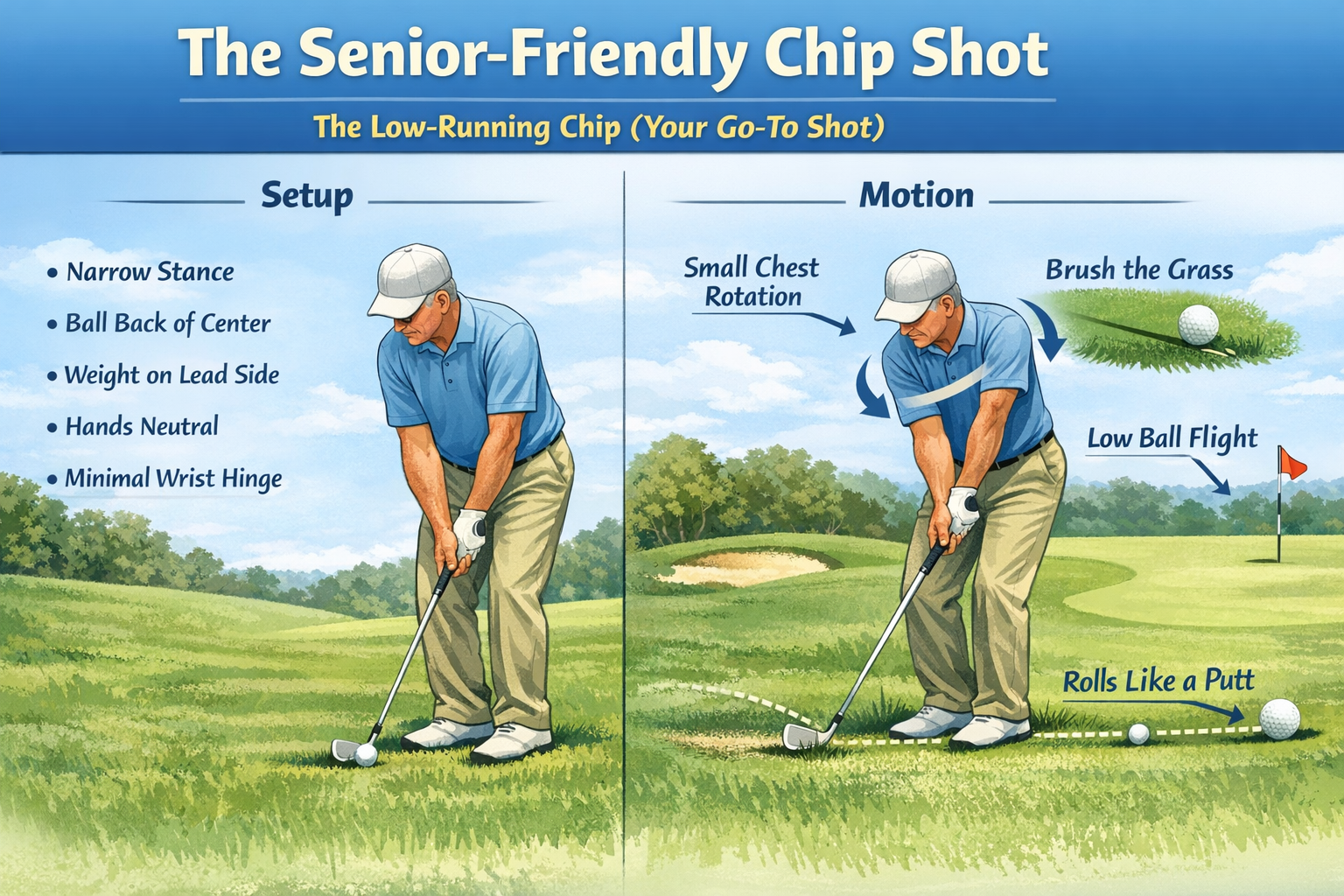
Set up 10-20 balls around the green: Vary the lies and the clubs used.
One-club short game: Practice using only a 7-iron or pitching wedge for bump-and-runs from different lies.
Landing spot drill: Place a towel on the practice green and try to land your chips on it from varying distances.
Putting Practice
Distance control: Use three balls at different distances (3, 6, 9 feet) and practice lag putts.
Consistent routine: Develop a pre-putt routine and stick with it.
Pressure putts: Create mini-competitions with friends or play “worst-ball” where you only count your worst putt.
Tip: Spend at least 50% of your practice time on the short game.
Step 4: Adapt the Full Swing for Your Body
Senior golfers can still have a powerful, effective swing by adapting to changing bodies:
Sponsored Links
Shorter, more controlled backswing: This reduces stress on the back and shoulders and helps with accuracy.
Emphasize sequence: Focus on a smooth weight shift and body rotation. Use training aids like an alignment stick or towel under the arms to feel proper connection.
Balance drills: Stand with feet close together and make half-swings, focusing on maintaining balance throughout.
Club and Equipment Check
Senior flex shafts: These help generate more clubhead speed with less effort.
Lighter grips or larger sizes: Accommodate weaker grip strength and arthritic hands.
Custom fitting: Consider a club fitting every few years, as swing speeds and needs change.
If you’re losing distance after 60, the good news is you may be able to get much of it back without swinging harder. One day your 7-iron is carrying a comfortable number. A season or two later, you’re reaching for one more club and wondering where the yardage went. If that sounds familiar, you’re not…
The golf cart rule most golfers forget is simple, but ignoring it can lead to accidents, damaged golf carts, and even costly repairs on the course. At Senior-Golfers.com, we focus specifically on how the golf swing, equipment, and practice change after 60. If you’re looking for senior-friendly golf advice, start here. Golf carts make the…
Why the Right Compression Ball Can Add Distance and Control for Senior Golfers At Senior-Golfers.com, we focus specifically on how the golf swing, equipment, and practice change after 60. If you’re looking for senior-friendly golf advice, start here. 9 minutes read time Just want the quick answer? ⭐ Quick Summary: Best Golf Balls for Senior…
If there’s one part of golf that truly belongs to experienced players, it’s the short game for seniors. After 60, we may lose a little swing speed. We may not hit it as far as we once did. But scoring? Scoring still belongs to the golfer who controls the ball from 100 yards and in.…
The shoulder turn in golf is a crucial component of a successful golf swing. It is a fundamental movement that allows golfers to generate power, maintain accuracy, and achieve optimal distance. While it may seem simple, mastering the shoulder turn can be challenging, especially for senior golfers. In this post, we will explore some tips…
There’s a moment that happens to almost every golfer over 60. You’re on the range.You make a swing.And you think: “That didn’t used to feel this hard.” Not painful.Not broken. Just… harder. At Senior-Golfers.com, we focus specifically on how the golf swing, equipment, and practice change after 60. If you’re looking for senior-friendly golf advice,…
15 min putting drills (lag, accuracy, and pressure putts)
Full Swing (30 min):
10 min balance and sequence drills with half-swings
10 min hitting irons, focusing on quality contact
10 min driving, emphasizing rhythm over power
Cool Down and Stretching (10 min)
Performance Review (optional): Reflect or jot down notes on what went well and areas for improvement.
Integrating Fitness Into Practice
Strength, flexibility, and balance exercises are vital for both effective practice and injury prevention :
Resistance band exercises: Improve shoulder and hip strength.
Yoga or Tai Chi: Enhance balance and flexibility.
Walking: Increases endurance and burns calories—walking the course instead of using a cart can be added conditioning.
Practicing With Purpose
Randomly hitting balls on the range is less efficient than focused, goal-oriented practice. Seniors should:
Set specific objectives: Instead of “hit better,” try “make solid contact with 80% of 7-iron shots.”
Use feedback: Video your swing, use launch monitors, or ask for help from PGA professionals specializing in seniors.
Incorporate variety: Challenge yourself with new lies, slopes, and weather conditions.
Social and Fun Aspects
Golf is social, and practice can be too:
Join senior clinics or group lessons: Benefit from camaraderie and shared learning.
Make practice games: Friendly competitions during practice maintain motivation.
Adapting to Limitations
If mobility or chronic pain is a concern:
Focus on short game and putting more, as these demand less physical exertion but add the most value.
Work with a physical therapist or golf-specific trainer to adapt movements to your abilities.
Always consult a healthcare provider before starting new routines, especially if you have chronic conditions.
Embracing Technology
Modern technology is highly beneficial for senior golfers:
Swing analyzers and launch monitors: Help identify swing flaws and track improvement.
Online instruction: There are many senior-focused videos and articles available.
Golf fitness apps: Track flexibility, strength, and practice routines.
Conclusion
Golf is a lifetime sport, and with a smart, adaptive approach to practice, seniors can continue to play at high levels of enjoyment and competitiveness. Key takeaways include:
Warm up properly and respect your body’s changing needs.
Focus on fundamentals and short game.
Use equipment that matches your strength and flexibility.
Practice purposefully, prioritizing consistency and course management.
Add fitness and mental training to your routine.
Remember, longevity in golf and continuing to lower your scores comes from working smarter, not necessarily harder. With these structured practice strategies, senior golfers can maximize enjoyment, improve skill, and maintain their love for the game.
Happy practicing, and may your next round be your best yet!
Allen is a seasoned golfer who has been playing the sport for over 50 years, mostly in the Northwest, and now calls Idaho home. Throughout his life, he has actively participated in various sports, including snowboarding and windsurfing in the Columbia Gorge. Allen passionately believes that “Golf is Life” and is dedicated to helping fellow senior golfers make the most of their senior years