Most golfers over 60 assume that losing distance is simply part of getting older.
While age does bring changes in flexibility, strength, and mobility, many senior golfers lose more distance than necessary because of one overlooked issue:
A restricted hip turn.
When it comes to hip turn for senior golfers, even small limitations in rotation can have a surprising impact on distance, consistency, and overall swing efficiency.
The good news is that you don’t need the flexibility of a tour player to improve your hip turn. In fact, small improvements in rotation can lead to better contact, more consistency, and additional distance without swinging harder.
If you’ve ever felt like you’re making a full swing but the ball simply doesn’t travel as far as it used to, your hips may be trying to tell you something.
Why Hip Turn Matters More After 60
As we age, our bodies naturally lose mobility. The hips become tighter, the lower back becomes less flexible, and many golfers begin compensating with their arms and hands.
When the hips stop turning properly:
The backswing becomes restricted
The arms dominate the swing
Clubhead speed decreases
Consistency suffers
The lower back often works harder than it should
Many senior golfers try to solve these issues by swinging harder. Unfortunately, that usually creates more problems.
A better solution is learning how to turn your hips more efficiently. Hip turn for senior golfers.
Senior Insight
Distance doesn’t come from effort.
Distance comes from sequence.
Many golfers over 60 are surprised to discover that their hips have almost stopped turning during the backswing. Once they restore even a modest amount of rotation, they often regain distance without increasing swing speed.
Signs Your Hip Turn Is Restricted
Many golfers don’t realize their hip turn has become limited because the change happens gradually over time.
If any of the following sound familiar, restricted hip rotation could be affecting your swing:
Your backswing feels shorter every season.
You struggle to make a full shoulder turn.
Your drives seem to have lost distance.
You feel like your arms are doing all the work.
You pull shots left or leave the clubface open.
Your lower back is sore after a round.
The body is incredibly good at finding ways to compensate. Unfortunately, those compensations often create inconsistent ball striking and place extra stress on the joints. Hip turn for senior golfers FAQ.
Many senior golfers discover that improving hip mobility helps their shoulders turn more freely, which improves both distance and consistency.
The Most Common Hip Turn Mistake
The biggest mistake senior golfers make is trying to keep their lower body completely still during the backswing.
Many were taught to:
Keep your head still.
Don’t sway.
Stay centered.
Unfortunately, some golfers interpret that advice as:
“Don’t move anything below your shoulders.”
The result is often:
Restricted hip turn
Flat shoulder turn
Arms-only swing
Loss of power
Poor sequencing
Your hips should rotate naturally during the backswing. They are not supposed to remain frozen.
One of the biggest misconceptions in golf is that shoulder turn and hip turn are separate movements.
They work together.
When the hips rotate naturally, the shoulders can complete a fuller turn. When the hips are restricted, the shoulders often stop turning as well.
Think about it this way.
If you lock your lower body and attempt to make a full shoulder turn, you’ll quickly feel tension and resistance. Your body simply runs out of room.
Allowing the hips to rotate creates space for the upper body to move.
This becomes increasingly important after age 60 when flexibility naturally declines.
Senior Insight
Many golfers over 60 spend years trying to increase shoulder turn when they should be improving hip turn.
Often the shoulders are not the problem.
The hips are.
How Much Hip Turn Do Senior Golfers Need?
You do not need to turn your hips 45 degrees like a PGA Tour professional.
For most senior golfers:
25 to 35 degrees of hip rotation is plenty.
The goal isn’t maximum rotation.
The goal is efficient rotation.
A comfortable hip turn allows the shoulders to complete a fuller backswing while reducing strain on the lower back.
Callout Box
How to Check Your Hip Turn
Most senior golfers only need about 25–35 degrees of hip rotation during the backswing.
Here’s a simple checkpoint:
As you turn back, your trail pocket should rotate behind you, and your belt buckle should point roughly halfway between the golf ball and your trail foot.
If you can make that turn while maintaining your balance and posture, you’re likely in the ideal range.
Remember, the goal isn’t a bigger turn—it’s a better turn.
⛳ Don’t chase more rotation. Chase efficient rotation.
How Hip Turn Can Affect Your Lower Back
Many senior golfers are surprised to learn that restricted hip mobility may contribute to lower back discomfort during the golf swing.
The golf swing is a rotational movement that requires the body to work as a connected system. Ideally, the hips, torso, shoulders, and arms all contribute to the turn.
When the hips lose mobility, however, the body often finds another way to complete the swing.
Unfortunately, that “other way” frequently involves the lower back.
Why This Matters After 60
As golfers age, it is common to lose some hip mobility. Tight hip muscles, arthritis, previous injuries, and years of sitting can all reduce the hips’ ability to rotate freely.
When the hips don’t turn efficiently, many golfers compensate by increasing movement through the lumbar spine (lower back).
The problem is that the lower back is not designed to be the primary source of rotation in the golf swing.
Over time, repeatedly asking the lower back to create motion that should be coming from the hips can increase mechanical stress and contribute to discomfort.
This doesn’t mean restricted hip turn automatically causes back pain.
However, sports medicine specialists and golf fitness professionals commonly recognize that limited hip mobility may increase the workload placed on the lower back during rotational activities such as golf.
The Senior Golfer Example
Imagine two golfers making the same backswing.
Golfer A
Hips turn approximately 30 degrees
Shoulders turn approximately 80 degrees
Rotation is distributed throughout the body
Golfer B
Hips turn only 10 degrees
Shoulders still attempt to turn 80 degrees
The lower back often absorbs more rotational stress
Neither golfer may notice a problem immediately.
But after hundreds of practice swings and dozens of rounds each season, the difference can become significant.
Warning Signs Your Hips May Be Making Your Back Work Too Hard
You may benefit from improving hip mobility if you:
Feel tightness in your lower back after playing
Experience stiffness the morning after a round
Struggle to complete your backswing comfortably
Feel “stuck” during the swing
Notice your posture rising during the backswing
Have lost both distance and flexibility over time
Senior Insight
Many golfers assume a stiff back is preventing them from turning.
Sometimes the opposite is true.
Tight hips may force the lower back to work harder during the swing. Improving hip mobility won’t solve every back problem, but it can help many golfers move more efficiently and comfortably.
Better Hip Turn Can Mean Less Stress
One of the hidden benefits of improving hip turn isn’t just more distance.
It’s often a more comfortable swing.
When the hips rotate efficiently, rotational forces are shared throughout the body rather than being concentrated in the lower back.
That can lead to:
Improved mobility
Better balance
More efficient sequencing
Less compensatory movement
Greater comfort during and after the round
For many golfers over 60, that’s just as valuable as gaining a few extra yards off the tee.
Common Hip Turn Myths
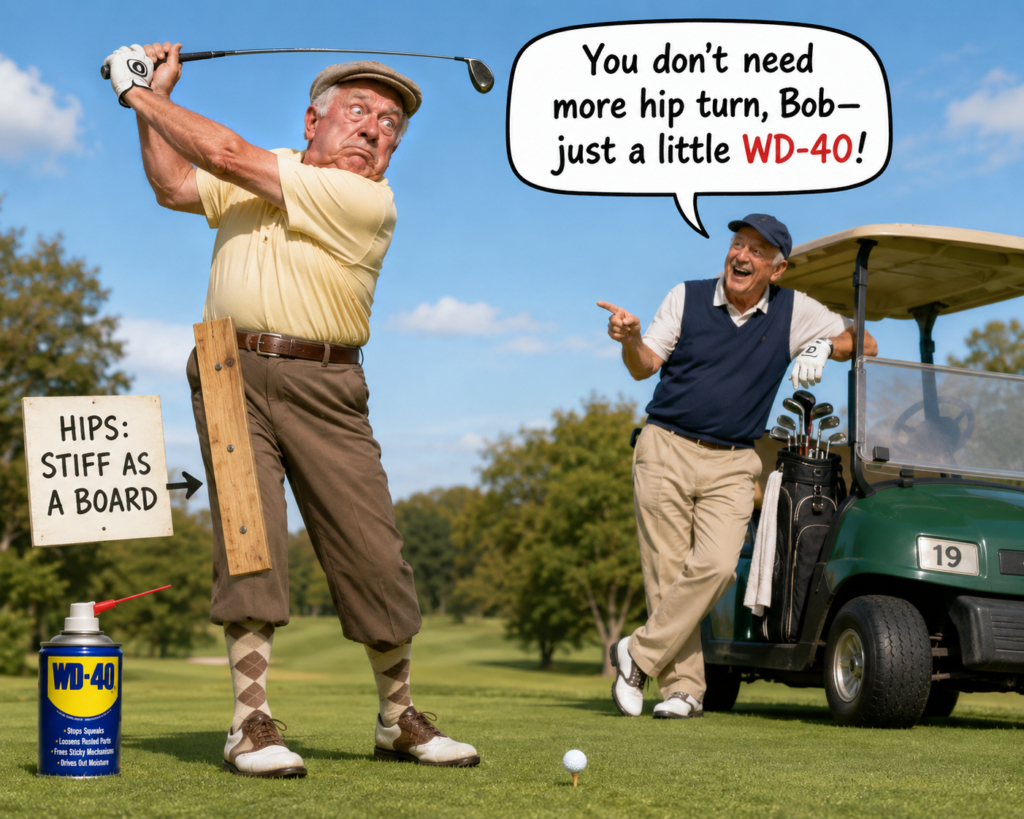
Myth #1: Keep Your Lower Body Completely Still
This advice has hurt more senior golf swings than it has helped.
While excessive swaying is a problem, the hips should rotate during the backswing. Restricting them completely usually reduces power and consistency.
Myth #2: Bigger Hip Turn Is Always Better
Some golfers hear they need more hip turn and immediately try to rotate as far as possible.
That is not the goal.
A balanced, comfortable turn is far more important than a large turn.
Myth #3: Only Flexible People Can Improve Their Hip Turn
You don’t need to be able to touch your toes or perform yoga poses.
Most golfers can improve mobility through simple stretching and movement exercises.
Even small gains often produce noticeable results on the golf course.
At Senior-Golfers.com, we focus specifically on how the golf swing, equipment, and practice change after 60. If you’re looking for senior-friendly golf advice, start here.
A Simple Hip Turn Self-Test
Try this quick test at home.
Cross your arms over your chest.
Assume your golf posture.
Slowly rotate your shoulders as if making a backswing.
Notice whether your trail hip turns behind you.
If your shoulders stop turning because your hips stop turning, you’ve likely discovered one of your biggest distance killers.
Best Hip Mobility Stretches for Senior Golfers
Before trying to improve your swing, it helps to improve your body’s ability to move.
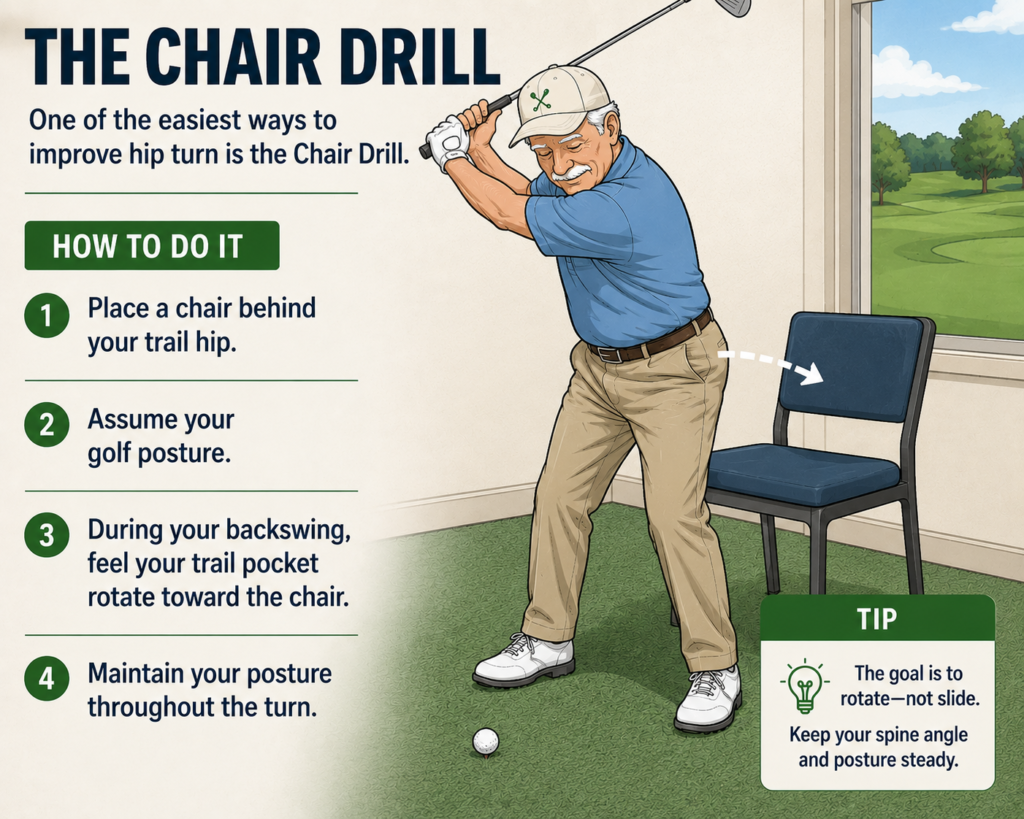
The Chair Drill
One of the easiest ways to improve hip turn is the Chair Drill.
How To Do It
Place a chair behind your trail hip.
Assume your golf posture.
During your backswing, feel your trail pocket rotate toward the chair.
Maintain your posture throughout the turn.
This teaches proper rotation while preventing excessive sway.
Practice this drill for just a few minutes each day.
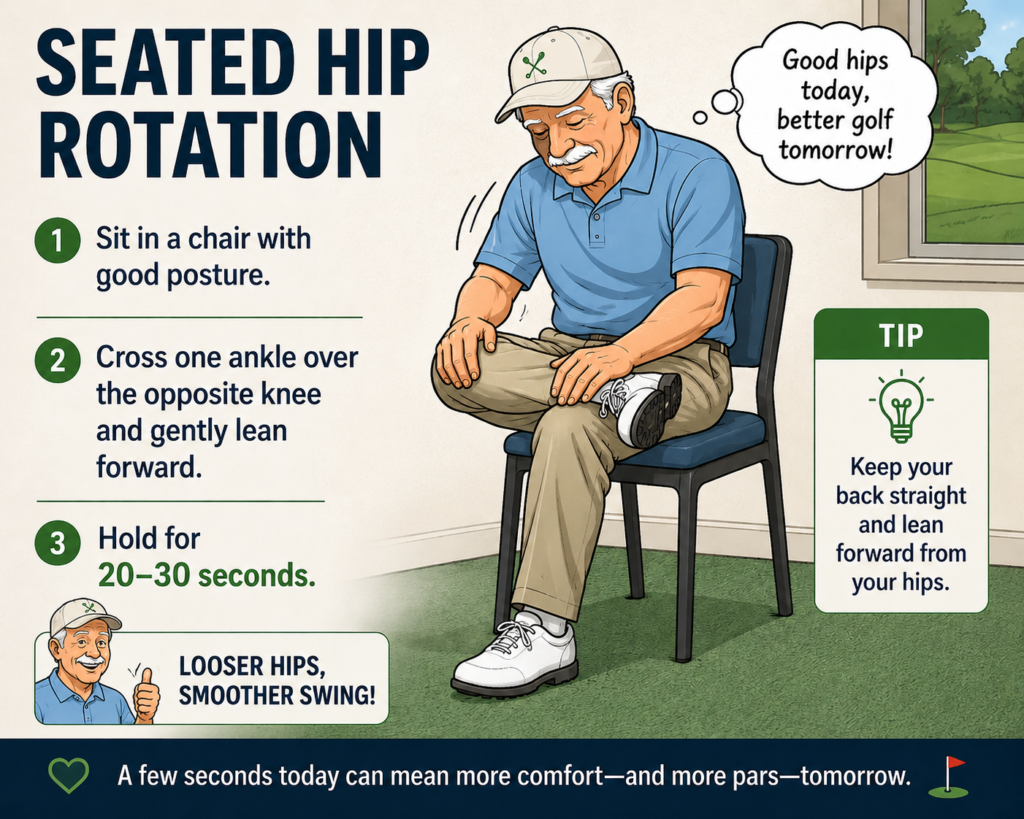
Seated Hip Rotation
Sit in a chair with good posture.
Cross one ankle over the opposite knee and gently lean forward.
The goal is not to become more flexible than you were at age 30.
The goal is to move well enough to make a comfortable, athletic golf swing.
What Better Hip Turn Does For Senior Golfers
Improved hip rotation often leads to:
More Distance
A better turn creates more coil and better sequencing.
Better Ball Striking
The club approaches the ball more consistently.
Less Effort
Many golfers find they can swing easier while producing better results.
Less Stress on the Back
Proper rotation distributes forces throughout the body instead of forcing the lower back to do all the work.
Equipment Won’t Fix a Poor Hip Turn
Golfers love equipment.
And modern equipment can absolutely help.
But if your body cannot rotate efficiently, there is a limit to how much a new driver or shaft can improve your game.
That’s why many senior golfers see only temporary improvements after buying new clubs.
Final Thoughts
If you’re a senior golfer looking for more distance, better consistency, and less strain on your body, don’t immediately assume you need a new driver or a completely new swing.
Start by evaluating your hip turn.
The ability to rotate efficiently is one of the foundations of a good golf swing at any age.
A little more mobility.
A little more rotation.
A little more awareness.
Those small improvements can make a big difference over the course of a season.
Remember, golf after 60 isn’t about swinging harder.
It’s about moving better.
Health Disclaimer
This article is for educational purposes only and is not medical advice. Consult your healthcare provider before starting any new exercise or stretching program. Stop immediately if you experience pain during any movement.
Frequently Asked Questions
Should senior golfers try to increase hip turn?
Yes. Most golfers over 60 benefit from improving hip mobility and allowing a more natural hip turn. The goal should be comfort and efficiency, not forcing extra rotation.
Can poor hip turn cause slices?
Yes. Restricted hip movement often leads to an arms-dominated swing, which can contribute to slices and weak shots.
How much hip turn should a senior golfer have?
Most senior golfers perform well with approximately 25–35 degrees of hip rotation during the backswing.
Does improving hip turn increase distance?
For many golfers, yes. Better hip turn improves sequencing, creates more coil, and helps generate speed without additional effort.
What is the best hip turn drill for senior golfers?
The Chair Drill is one of the simplest and most effective drills because it teaches proper rotation while maintaining posture.
Can hip turn help reduce back pain?
In many cases, yes. Proper rotation allows the body to share the workload and often reduces stress placed on the lower back.
🔔Want more senior-specific golf tips? Join the Senior-Golfers.com Newsletter and get practical advice, equipment insights, and bonus guides delivered monthly — no spam.
AI golf instruction is becoming one of the newest ways golfers can use artificial intelligence to improve their game. AI can already write an email, plan a vacation, answer questions, analyze photographs—and now it can even analyze your golf swing. But can it actually help you play better golf? That was the question I wanted…
How Tee Height and Ball Position Can Help Senior Golfers Launch It Higher, Find the Center of the Face, and Get More From Their Driver One of the easiest ways for senior golfers to gain more from the driver is to check driver tee height for senior golfers and ball position before making another swing…
Sometimes the best golf memories aren’t made on the golf course—they’re made afterward. 2-night golf getaways for senior golfers are one of the best ways to enjoy great golf, reconnect with friends, and recharge without spending a week away from home. Sometimes, the best golf memories aren’t made by shooting your lowest score—they’re made around…
Allen is a seasoned golfer who has been playing the sport for over 50 years, mostly in the Northwest, and now calls Idaho home. Throughout his life, he has actively participated in various sports, including snowboarding and windsurfing in the Columbia Gorge. Allen passionately believes that “Golf is Life” and is dedicated to helping fellow senior golfers make the most of their senior years






Comments